You’d love to have a high-converting blog that showcases your expertise and gets you clients… but you’re worried that writing just… isn’t your thing.
Maybe you overthink your words. Maybe you stare at a blank page and freeze. Maybe writing 2,000+ words just feels like a lot to you.
And so even though you know you want a blog… You’re low-key afraid it’s not possible for you.
Well…
I have such good news, Friend:
👉🏼 You really don’t have to be a “good writer” to write blog content that brings in clients.
Really. I promise. Let me explain…
In this blog post…
- I’ll share what it actually *does* take to write effective blog posts that get you clients. (Spoiler: you don’t need a crazy vocabulary, natural creativity, or perfect sentence structure!)
- I’ll show you some of the tools and structures you can lean on, that can help you write high-converting blog content with those things! 🙂
- I’ll share some super-helpful beliefs I’ve culitivated (and you can too!) … These have helped me personally, when I’ve struggled with thinking I need to be a “good writer” to have an effective blog.
I want every service-based business owner out there to know that you *can* have a high-converting blog — and you don’t need to be a Hemingway or a Bronte to do it. 😉
So let’s jump in.
First, I need you to truly embrace this…
Writing effective marketing blogs isn’t about being poetic or imaginative.
It’s easy to come at marketing thinking you’re absolutely going to need to be a “good writer.”
And you’re not the only one who’s picked up that belief…
For a lot of people, it started way back — if writing felt hard for you, or you got feedback in school that maybe writing just wasn’t your strength… And then fast-forward to today, where you’re constantly hearing things like “your copy is everything” or “good copy is what makes or breaks sales.”
So it’s been easy to conclude that being a good marketer = being a gifted writer…
But the truth is: Writing helpful and persuasive content that gets people buying isn’t really about being a gifted writer at all.
More than anything, it’s about identifying the things your audience really cares about — the problems they’re facing (that you can help solve), the goals they dream about, the questions that keep popping up in their minds — and writing about those things, in plain language.
Basically they care more about what you can help them solve or do, than how creative, clever, or well-structured your words are.
It’s also about bringing your unique ideas to the table and letting your expertise shine.
You’ve learned things. You’ve seen patterns. You have opinions about what actually helps people move forward — and that perspective is incredibly valuable. Sharing your real thoughts, experiences, and beliefs (even if it feels simple or obvious to you) is what helps your audience trust you and see you as the right person for them. You just need to show up as the expert you already are.
And finally, it’s about putting your ideas into a format that makes sense, so your reader can clearly understand what you want them to see, know, or believe — to be ready to buy.
When your content is organized in a way that clearly guides someone from “I’m confused” to “Ohhh, now I get it,” that’s what makes your writing powerful. Not perfectly-formed sentences. Not clever metaphors. Just clear, simple structure that helps people connect the dots.
And here’s the thing…
Even if you’re reading this and thinking, “But I’m not sure what my audience wants to read.” or “I’m not sure I know how to format something so it reads well…”
That’s okay, too.
I can help you with that.
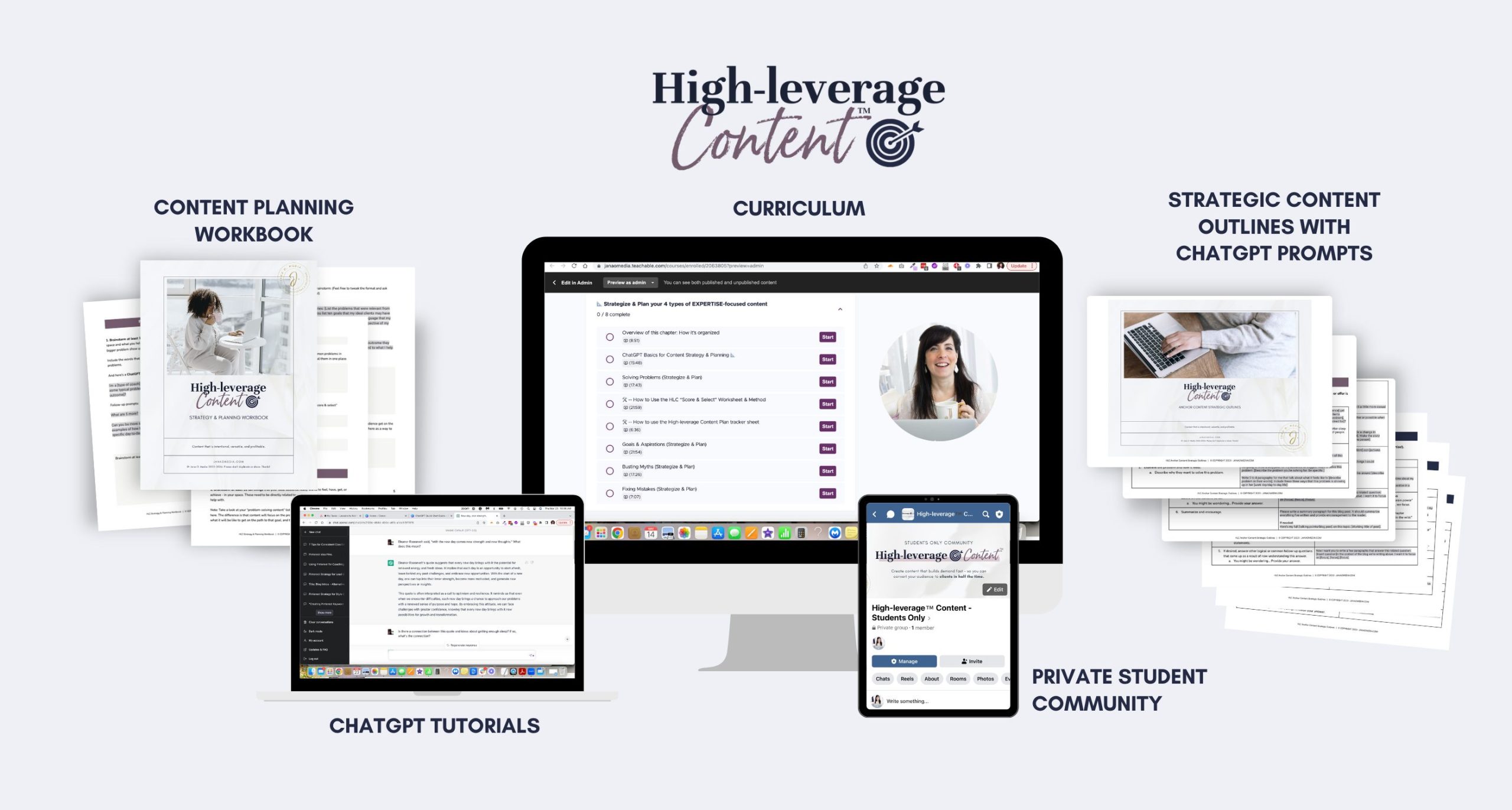
99% of people who join High-leverage Content (my blog and content program) DO NOT naturally know how to do all that already — and they still come in, choose great topics, and write blog posts that get them clients.
So that’s literally why my program exists — to guide you in how to do this.
And I’ve built structures and tools into HLC that you can lean on — so that you don’t have to *already know* how to do this.
Let me tell you about a couple of them…
✍🏼 ‘The HLC Strategic Blog Outlines:
HLC-ers tell me these outlines are what finally gets them to stop over-thinking about what a blog should say — because you have a model to follow.
I sometimes describe these Outlines as “Mad Libs, but more nuanced.” 😂
Here’s what they are:
For each of the 9 blog types we write inside HLC (the HLC ‘9-in-2’ Content Pillars), you get a re-usable outline that walks you through exactly what to say — and in what order.
Each outline is like a fill-in-the-blanks guide — but instead of one-size-fits-all templates, they’re built to help you draw out your own voice, message, and expertise.
They spell out:
✔️ What kind of hook and intro will grab your reader and set up the problem / topic clearly
✔️ How to structure the body of the post — depending on whether you’re showcasing a framework, busting a myth, handling an objection, etc.
✔️ Where and how to naturally include your call to action at the end — whether that’s for your email list or your paid offer
(and lots more!)
You’ll see notes in the Outlines like:
→ “Describe what this problem feels like – and why. Use at least three adjectives.”
→ “Imagine the reader’s day… What are some specific ways (smaller problems) when/where this problem shows up for them.? Little things like getting frustrated with not having clothing that fits in the morning, and finding an outfit takes too long and makes her late to work… or needing coffee at 3pm and again at 4pm to get through the day…”
→ “Explain why this mistake is so common — and why it’s not your reader’s fault or she’s not the only one. Here are examples…”
→ “Here’s where you can add a question that your reader might be wondering, based on what they’ve learned so far – and briefly address / answer that question.”
It’s like having me there, sitting right next to you while you write, saying,
“Okay, Friend — now explain this part… now make sure they understand why that matters… now invite them to take the next step.” 👯
And once you’ve written with these Outlines a few times, they start to become second nature. (They actually help you become a better writer!) You start thinking more strategically. Writing gets easier. And you realize you actually do know what to say — you just needed a path to get it out.
These outlines ensure that your content works — even if writing doesn’t come naturally to you.
They’re based on how real people think, what they need to hear and understand, to feel ready to change — and to conclude that you are the one who can help them do it.
They help you present your ideas and information in a way that is organized, cohesive, and above all, high-converting.
And if you still feel that writing just isn’t your thing — that’s where the HLC Blog Writing GPTs come in…
🤖 The HLC Blog Writing GPTs:
In the new curriculum spiff-up I did in early 2025, I added 9 specially-programmed GPTs for you to use when you are drafting your blog posts.
There are nine of them, too, because there is one for each of the types of content we write in HLC (the 9-in-2 Content Pillars).
(NOTE: Using AI is 100% optional inside HLC, but these are very cool — so you should try ’em, no matter whether you plan to use them or not!)
These GPTs are super-easy to use (I promise!) and they generate a first draft of your blog post, in seconds. So that means you don’t even have to write full paragraphs from scratch if you don’t want to. 😅Just bring your ideas and opinions — these tools will help shape them into client-attracting content.
The reason they can do this is that I pre-programmed them to know the HLC Strategic Outline structures. So they combine your thought leadership ideas with those tried-and-true structures.
(BTW… In case you’re wondering, here’s what a GPT is, in everyday terms: It’s a ChatGPT chat that has been given specific, written instructions on the back end by someone – in this case, me 🙂 – to generate written content in very specific ways… These live in your ChatGPT account and they work just like any other chats, except they know stuff about HLC. 🙂 In this case, I’ve pre-programmed them to know the structures of my road-tested outlines, and use them to generate your draft.)
And here’s the best part…
Where it used to take DAYS to write a good blog post, it’s taking HLC students under 2 hours – outline to finished product. 😲
This tech is wild! No more searching for words. No more staring at a blank screen and a blinking cursor. No more losing an entire day to blog writing.
So, even if you don’t think of yourself as a gifted writer, you can use these to generate a blog post that is well-structured, easy-to-read, and formatted to be high-converting.
A quick personal confession: I don’t really think I’m a “good writer.”
I know, you might be surprised to read that… But it’s true. Somewhat ironically… I don’t actually consider myself a “great writer” either.
Writing doesn’t feel like something I avoid or anything — but when I write, I tend to be a little rambly. I like to use a lot of words. I’ll happily go off on a massive tangent if you let me. 😁
And still — even though my blog posts over the years haven’t been perfect…
They’ve converted hundreds of clients and students into my offers.
Not because the writing is flawless — but because it’s strategic.
I follow proven outlines, based on what I know works. I write about the right topics (the ones that give my audience what they need, to be ready to buy).
And yes — I lean on AI a little bit (but not too much!) to make my content more readable.
Those are my secrets… Not being “an excellent writer.” (Shhhhh. Don’t tell anyone. Imagine… A blog coach that doesn’t think of herself as a good writer. It’s so “Gen X” of me…🤣)
A Few Beliefs to Keep With You While You Learn to Blog for Clients
Before we wrap up, I want to leave you with a handful of grounding beliefs — the same ones I come back to again and again when I’m teaching my students how to blog for their businesses.
And I’ll say this honestly:
I think the reason writing has generally felt relatively natural for me over the years is because I’ve never tried to be a “good writer.” I don’t worry about sounding impressive or poetic. Instead, I fully embrace the fact that my writing doesn’t have to be perfect to convert — it just has to be clear, honest, and helpful.
And that’s what I want for you, too.
Here are a few beliefs that can really support that mindset:
👉🏼 Clarity beats cleverness.
Your readers don’t need lyrical sentences — they need clear, straightforward ideas that show you understand them and have solutions they need.
👉🏼 Your message matters more than your mechanics.
A slightly awkward sentence that truly helps someone see what’s possible? That converts far better than perfectly-crafted prose that doesn’t move the needle.
👉🏼 Your expertise and experiences are the real value.
The years you’ve spent learning, practicing, observing… that’s the gold. Writing is just the vehicle that delivers it.
👉🏼 You have my full permission to be “basic” in your writing.
If you sometimes worry your writing is too simple or “not profound enough,” that’s a good sign — not a bad one. The people who are still learning — the ones you’re meant to help — aren’t looking for earth-shattering ideas. They’re looking for someone who can clearly explain the essentials and lay things out in a way that finally makes sense.
If you keep these thoughts close as you build your blog, you may find — like I did — that writing doesn’t have to feel precious.
It can simply be a really effective way to help people, build trust, and invite the right clients into your world.
Next Steps: Start your blog, and get clients with it — with High-leverage Content.
So if this question — “But what if I’m not a good writer?” — has been hanging out in the back of your mind and quietly stopping you from starting your blog…
Let’s rewrite that story right now.
Because your ability to get clients from your blog content has so much less to do with being a gifted writer — and so much more to do with having a repeatable, strategic system that guides your thinking, your structure, and your writing.
When you know:
✔️ what your audience actually needs to hear
✔️ what a high-converting blog needs to say and include
✔️ how to organize your ideas clearly
✔️ and how to connect your content back to your offers
…blogging stops feeling overwhelming or intimidating — and starts feeling calm, focused, and effective.
And that’s exactly what High-leverage Content gives you! It’s a complete, supportive system that helps you choose the right topics, plug your ideas into proven outlines, and (if you want) use AI to turn your thoughts into polished drafts — without losing your voice or your integrity.
You bring the expertise. The HLC tools do the heavy lifting.
If you’d love your blog to finally start working for you (without the constant pressure to be brilliant on the page), you can learn more and enroll here.