This post is for all my fellow service pros — web and brand designers, social media managers, Pinterest managers, OBMs and VAs…
Anyone running an online service-based business! I see you.
I was you… 🤗
So know that marketing your own business consistently as a service provider can be a challenge.
It’s ironic, right? You help your clients get visible, clarify their messaging, or strengthen their brand/business in some way… but when it comes to your own content?
😵💫 It’s always on the back burner.
😬 You’re posting inconsistently in spurts, only when client work slows down.
🫣 Tbh, You’re usually embarrassed at your own lack of marketing presence.
🤯 And when you do market, it often feels like you’re throwing content into the void. (Social media doesn’t seem to love that you show up out of the blue once or twice per quarter, having been silent for weeks. 🤷🏻♀️)
But a strong, strategic *blog-first* marketing system can change all that…
When you build a blog the right way, it can become the driving engine behind all of your marketing, and help you sign more clients, more consistently — without being a second full-time job for you.
So in this post, I’ll be spilling it all:
- My own blog story: How my blog got me booked-out, as a DFY service provider
- Why every online service provider needs a capsule blog — and how it works to get you clients
- The 3 steps to follow, to build a strategic blog that brings in clients — but doesn’t require loads of your time.
- Examples of service based business owners who use a blog and a blog-first marketing system, to sign clients 💃🏻
- Answers to some FAQs I get from service providers about blogs:
- What about SEO?
- What if I already have a blog, but it’s not working yet?
- What should I blog about?
I’m so excited to share all this tea! So let’s go…
I’ll start with a preface of sorts…
My Story: How my blog got me booked-out, as a DFY service provider
For 6 years, when I was doing DFY Pinterest setups and blog writing for coaches, I had VERY little time to do my own marketing.
But I stayed booked out, and always had a wait list. People often booked their time with me 1 to 2 months out, and made deposits to hold their spots.
Here’s how I did this:
I started a blog, and I decided to write about the main things that my ideal clients needed, to be ready to hire me. My blog posts became a library of my thought leadership content, and they were high-converting. (People quoted them on sales calls and came ready to sign up.)
Since I knew my blog was converting, I used it to create all the other content I needed. I just repurposed pieces of them to create the emails to my list and social posts I needed…
I set aside 1 day per month (that’s it!) for doing that repurposing. I repeated all those things I had written in my blogs… a lot.
Yes, I was nervous about always repeating my messages… Would my audience get bored? Did I seem lazy? …
But it worked:
✔️ I stayed booked out + always had a waitlist (with deposits).
✔️ I doubled my prices 4 times (to $3700)
✔️ I started getting speaking opportunities offered to me, every week.
✔️ I created other scalable + passive offers, to leverage all my visibility and the trust / expertise.
✔️ I made so much money!
✔️ And I got SO MUCH EXPERIENCE…
(I worked with more than 100 clients on their content and/or Pinterest – all coaches and service providers. And I served as Content Manager for 5 years for a 7-figure coach and brand strategist. Some of you may remember my client, Kaye!)
👆🏻 And allll of this happened, because I wrote 18 blog posts (aka my “capsule blog library”) and repeated my messages from them, over and over. 👈🏼👈🏼👈🏼👈🏼👈🏼
That’s why I believe that…
Every online service provider needs a Capsule Blog.
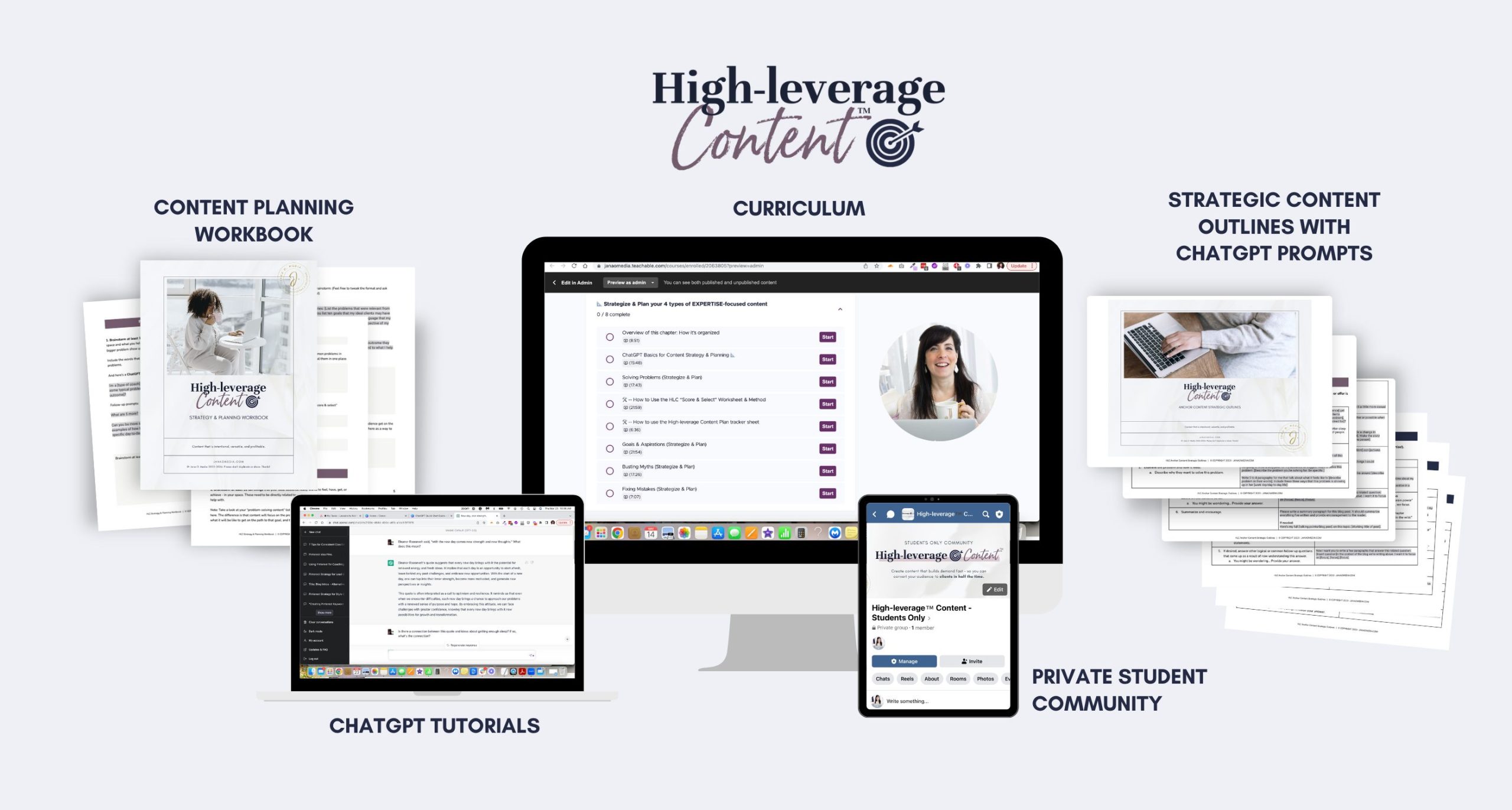
These days, I run a blog and content program called High-leverage Content (HLC for short!).
The first thing my students work on inside is building their very own Capsule Blog — defined as: 12 to 20 blog posts that cover all the key things your audience needs to hear, learn, and understand more deeply, to feel ready to buy. (More on this below!)
Just like the one I created back in the day, the blogs that my HLC students build become the foundation for an efficient (but very effective!) blog-first marketing strategy… One that gets them real ROI (clients!) but doesn’t require them to spend hours every week on marketing.
Having your own Capsule Blog Library means you have:
- A foundation of high-converting content – The key messages and things your future clients need to hear before hiring you, all in one place.
- A 24/7 trust-and-demand-builder – Evergreen blog posts that live on your website. They showcase the ROI or your work, and your expertise, even when you’re booked out and under a rock creating the deliverables. 😀
- Content you can repurpose endlessly – So when you do have time to post on social? It’s easy, and you’re just drawing on messages that you *already know* will convert. (Less wasting time.)
- An easier way to delegate – Want to outsource content distribution? This gives your VA or team a rock-solid foundation without them making up stuff that doesn’t sound like you.
This is how the service providers in my program get off the content treadmill — without losing revenue momentum between client projects.
Next up, I want to walk you through the three key steps you can follow (inside HLC with me, or on your own), to build a blog and get clients with it.
I’m spelling it all out… So keep reading, Friend!
(Pssssst…. You can 📌 pin this article for reference to your “Pinterest marketing” board:)
Step 1 – Get clear on what your audience needs from your blog content, to feel ready to buy. (Choose your capsule blog topics.)
The first thing you want to do, in preparation for building your blog, is to get clear on what your audience needs to hear, learn, and understand more deeply, to be ready to buy your offer.
👉🏼 This is how you will decide your content topics for your capsule blog library. It’s how you make sure that your blog will be full of high-converting messages.
I always use the saying, “Measure twice, cut once” to describe why it’s important to do this very intentionally, and thoroughly… Because your big-picture plan is to write high-converting content that covers the things people need, to feel ready to buy — and then to re-share and repeat those messages a lot, everywhere you like to show up. (More on that below.)
So it’s crucial that you choose the right topics… Because if you choose topics that are not relevant to your audience, or not closely enough related to your offer, you end up with some blog posts — but they aren’t really the key things your audience needs, to feel ready to buy. (And so they aren’t really going to work well when you share and repeat them.)
Point is: It’s worth spending time on the topic selection process — to get these right.
Here’s what I suggest:
(1) Start by casting a big net for ideas. Brainstorm *lots* of ideas (at least 50).
Use what you’ve learned by listening to clients or potential clients. Use your knowledge of your ideal audience’s problems, desires, interests, etc.
Use outside tools, too:
Inside HLC, I teach a ‘9-in-2’ Content Pillar system, and this helps my students a lot with brainstorming. These pillars are the nine things I write about in my blogs — the nine key things I have seen that people need, to feel ready to buy.
You can also use AI tools to brainstorm. (I teach a killer method for doing this with ChatGPT, inside HLC.)
(2) Evaluate all your topic ideas on three key factors:
Alignment, Relevance; and Ease.
These three factors make up the ARE framework I teach inside High-leverage Content. You can read more about that framework in this blog post. But the Reader’s Digest version is this:
- Alignment is about how closely your content is related to your paid offer(s). (So important! That way, it’s easy to talk about your paid offers inside your helpful content.)
- Relevance is whether (or not) your future clients care about what you’re saying. (Probably the most important of the three — its crucial that your topics feel important to your ideal audience, otherwise getting people to pay attention and read will always feel like pulling teeth.)
- Ease is how easy it is for *you* to get detailed on this topic. (Do you have enough to say about this to go deep on the topic and write 2,000+ words?)
This rating system is what I call the “Score & Select” method, inside High-leverage Content…
If you want to mimic it, assign every topic you brainstormed a “score” between 1 and 10, for each of these three factors. Add up the numbers for each topic. The topics that score the highest overall should become your capsule blog topics.
(Psssst… If you want a deeper dive on these three key factors – Alignment, Relevance, and Ease, this blog post of mine details them, and the three biggest mistakes I see people make when choosing topics for their blog. Technically, I wrote it for coaches, but the concepts are 100 percent applicable to the kind of business you run [and the kind I ran], too.)
Once you’ve chosen the right topics, it’s time to…
Step 2 – Write your 12 to 20 evergreen blog posts.
This is where you will systematically write and publish those pieces of content in a high-converting, low-lift way — in a place where your content is evergreen and doesn’t disappear: Your blog.
The pace at which you do this is really up to you.
When I wrote my first capsule blog (all about what my audience needed, to feel ready to invest in my Pinterest offer), I wrote them all over a couple of “seasons.”
I wrote the first five or so in one month — because I knew exactly what topics I wanted to tackle first (what my audience needed, to feel ready!). And then I took a couple of months off from blog writing. Then I circled back for another “season” of writing, and I banged out the rest over the course of three more months or so.
(Inside HLC, I offer a few different “cadences” that students can choose, but the truth is that there’s really no right pace to publish. We are building a capsule library of *evergreen* blog posts that will convert clients and serve as source material to repurpose from — for months and years. So it’s great to get them done, but there’s also no need to publish weekly or even monthly. I just say get them done when you have pockets of time. << Worth noting: This is one of the reasons why I give lifetime access when you join High-leverage Content. You can write and publish at your own pace. No pressure… Accountability, yes. But no pressure.)
The main tools that I give HLC students, to get your blogs written in a high-converting way are:
- The HLC Strategic Outlines*: These are my proven, plug-and-play blog frameworks that walk you through every paragraph of a what goes into a high-converting blog post, so you always know exactly what to say — and why it sells. There are nine of these (one for each type of content we write in HLC.)
- The HLC Blog Drafting GPTs: (Optional but awesome!): Custom AI drafting assistants built from my HLC outlines. These turn your brain-dumped thought leadership ideas (that you jot down based on the Outlines above) into a strong, human-first first draft — so you don’t have to spend hours getting your ideas into sentences and paragraphs.
*Each of the 9 Strategic Outlines (and nine types of content) have a different structure…
And you can see a high-level version of one of them in this free guide that I created.
(The guide is called “How to Write High-Converting Blog Posts — Fast!” — and has four of my favorite strategies for making sure blogs don’t take all day. 🙂 And one of those 4 strategies includes a glimpse at one of my HLC Strategic Outlines. You’re welcome! 🙂
Step 3 – Repurpose and leverage your blog posts all up and down your marketing.
This is where things get exciting… And you get to move into your “Repurposing Era.”
Once you have your blog posts published, you stop writing new blog posts, and focus instead on repurposing and repeating your built-to-convert messages from those blog posts in any/all places you want to show up (emails, social, speaking, etc).
Because you worked hard to choose the topics your audience needs, to feel ready to buy…
And because you wrote your blog posts in high-converting formats…
When you repurpose your blog content to create smaller pieces of content (micro-content like social or emails)… And even other types of long-form content (e.g. presentations, podcast episodes, Youtube videos)… All your repurposed content will also be high-converting.
And of course, you’ll save so much time — because you don’t need to re-invent the wheel on every platform. You’ll have one strong content strategy, and a blog-first marketing system that converts clients efficiently.
But most importantly, you’ll sign more clients, with less content — when you focus on repetition and repurposing, instead of on pumping out new content all the time.
The service providers who consistently make sales in their business are the ones who repeat themselves often, intentionally. (I always say, “Repeating your content doesn’t make you boring. It makes you money. 😲)
Because when you are saying right things — on repeat — people who need your help “get” you, remember you, trust you, and choose you.
So many HLC students say this is their favorite part… They no longer have to stress over coming up with new content ideas… Instead, they’re making sales with repurposed ideas from their capsule library. 😎
Speaking of that…
What’s possible for online service providers who build and leverage a Capsule Blog:
Much like what I experienced, my students also experience a variety of results from their capsule blogs:
Of course, the number one thing we want from our blog is clients, and this method doesn’t disappoint:
- Chiara, a Pinterest Manager, got three inquiries within hours of sharing her first HLC-style blog post, and signed one as a client. (And it was for a brand-new offer she had just created.)
- More recently, Chiara sold out every seat in a webinar she did, “just using repurposed content from my blog.”
- Alli, a brand and web designer, also booked a sales call from her first HLC blog post. For her, the person read the blog post; opted in to her email list from the freebie (the CTA of the blog), and booked a call on the same day.
- Stefanie, also a web designer, had someone book a discovery call directly from one of her blog post’s CTA. She was a totally cold lead who found the blog post when Stefanie shared it in a social post. She hired her on that call to re-do two websites.
- Angelica, also a brand and web designer, had a new client reach out after reading an HLC blog post that explored a pain point she had with her brand — and she hired her.
- Sara, a LinkedIN Strategist, sold 15 profile optimizations in just 3 months, using content from her blog. Eight of those clients mentioned her HLC *evergreen* blog content directly as part of why they bought. (And most them bought with no sales calls, because her blog so thoroughly covered what they needed, to feel ready.)
- Sara also regularly repurposes her blog into emails that sell her offers… And she shares her blog posts in DMs she sends to LinkedIN contacts, and they buy her offers!
These are just a few of the HUNDREDS of success stories that HLC students have reported… They are using their blog posts all up and down their marketing, and it works!
(And PS — It’s not *just* about signing clients. My HLC students also see all kinds of doors open for them, because of the work they do on (and with) their blogs, inside the program: They get offers to speak on high-profile podcasts and in summits… They grow their email lists and social followers… They have industry influencers sharing their blog posts with huge audiences… These blog posts work hard for you!)
💪🏼 💪🏼
Now… I can just hear your wheels turning, now that you’re really seeing how a blog can help you sign clients in your service-based business.
But, you may also have a few questions, so now I’m going to take a guess at what they are, and answer ‘em for you! 👇🏼👇🏼
Blog FAQ: What about SEO, Jana?
This might shock you, because online service providers have *really* been convinced that blogging and SEO are basically the same strategy…
But they’re not. Not the way I do it, and teach it.
Inside High-leverage Content, we take a completely different approach:
I teach you how to do “Unforced SEO” — a human-first approach that helps you write content that converts and naturally ranks, without chasing keywords.
We don’t start with keywords. We start with your audience. What do they need to hear, know, and understand more deeply — to be ready to hire you?
That’s what we write blog posts about.
With this method…
You don’t have to worry about getting overwhelmed trying to write “ultimate guides…” Or hating your keywords, and losing motivation after paragraph 5… Or ending up with a blog post that sounds robotic or keyword-stuffed, but doesn’t actually convert anyone… (Because these things are almost inevitable when you start a blog thinking you have to “do SEO” out of the gate… I see it literally all the time.)
Instead:
👉🏼 You get clients now — because you learn what your audience needs, to be ready to buy. And because your content speaks directly to the beliefs, desires, and questions your audience already has. Your blog becomes a tool for building trust and demand, not just “providing value.”
👉🏼 AND you set yourself up for SEO success later, too — because search engines favor content that’s written for real humans. When your posts are well-structured, relevant, and rooted in your actual expertise? They often rank without the forced keyword-stuffing or expensive SEO tools.
And I started teaching it this way, because it’s how I did SEO early on. First I wrote what my audience needed, to feel ready to buy. Later, some of those posts did end up ranking on Google (Yay!) but I didn’t wait around for that. (or get annoyed with keywords and not blog at all).
I wrote A LOT MORE 🤣about “Unforced SEO” (how I did it, what makes it different from traditional SEO, results my HLC students get with it, etc.) in this blog post: The ‘Unforced SEO’ Blog Strategy That Got Me Booked Out With Clients.)
Blog FAQ: What if I already have a blog? Should I start over? Use what I have?
Coming soon…
Should online service providers really write “thought leadership” blogs? 🤨
I can just hear your thoughts now… Some of you are thinking:
“What will I blog about? I mean… I’m not really ‘a thought leader.’ I just do good work.”
I get it. You’re busy delivering results for clients, not writing hot takes or branded, acronym-laden frameworks. You “just do the work.” (And you are damn good at it!)
But here’s the truth:
In 2026, thought leadership is going to be your secret to standing out as a service pro. When the market feels slower, when referrals aren’t rolling in as easily, when great work isn’t automatically enough to stand out — that’s when thought leadership becomes your edge.
(And lets be real, that’s where we are. I’ve been hearing it again and again lately from designers, copywriters, podcast managers, and other done-for-you pros: “Inquiries are down. People are taking longer to decide. It feels harder to stand out.)
Clients have more options now, and they’re craving clarity about who’s right for them. When everyone’s promising “websites that convert” or “psychology-driven sales copy” or “systems that work as hard as you do” — what makes someone choose you?
It’s your point of view. Your process. Your way of thinking about the work.
And that’s actually what thought leadership is.
And it doesn’t have to look like posting spicy hot takes just to be a contrarian… or long philosophical essays. 😂For service providers, thought leadership simply means:
✔️ Showing what you believe about your craft.
✔️ Explaining why/how you do things differently.
✔️ Helping potential clients understand the deeper thinking behind your process and results.
Inside High-leverage Content, this happens naturally — because the process I take you through, step-by-step, forces you to put your thought leadership ideas into words. (Yes! Even if you’re not sure you have any — they are there, I promise you!)
Next steps: Join High-leverage Content and build your capsule blog library.
Inside High-Leverage Content, I’ll show you exactly how to build a Capsule Content Library that works to get you clients, on repeat.
You get:
✔️ The HLC “9-in-2” Content Pillars – You’ll know exactly what posts to write, so your content speaks directly to the desires, objections, hesitations, and questions potential clients have before hiring you. (No more waiting for “warm leads” to magically show up.)
✔️ Step-by-Step Strategic Blog Outlines – Plug-and-play frameworks that guide you paragraph by paragraph — so you can write content that attracts ready-to-invest clients faster, without second-guessing yourself.
✔️ AI-Powered HLC Writing Assistant GPTs – These tools help you write faster without sacrificing quality or brand voice. My students have gone from spending 14+ hours on a blog post to just 2 hours.
✔️ My 4-Step “Light & Logical” Writing Process – A simple, repeatable system that makes writing easier and ensures you actually finish your posts — so they can start working for you instead of collecting dust in Google Drive.
(and more!)
This is how service providers stay booked out — without feeling like you have two full-time jobs. (One is doing the service; the other is marketing it.) 😂
You’ll get lifetime access to HLC, when you join, too — because this is a repeatable system that you’ll be using in your business for months and years, any time you want to create some new marketing content.
High-leverage Content (HLC) is based on the system I built during my own 5+ year era as a booked-out service providers.
I used it to keep myself booked out and growing — and I used it for clients who wanted this kind of powerful, easeful content, too.
And now I want to show you how to do the same!
Join us!